DFT introduction #1
Team Rutgers(Valeria, Ezekiel and Michele) |
 |
| An interactive session |
Retrieve this presentation at:
mini ASESMA 2026 \(\bullet\) Accra, Ghana \(\bullet\) June 16, 2026
Goals of this lecture#
Reasons for considering DFT
Basics of the theory behind DFT and Kohn-Sham DFT
KS equations and XC functional
Split into N groups#
Assign number
1-Nto each studentGroups sit together
Possibly have 1 instructor per group
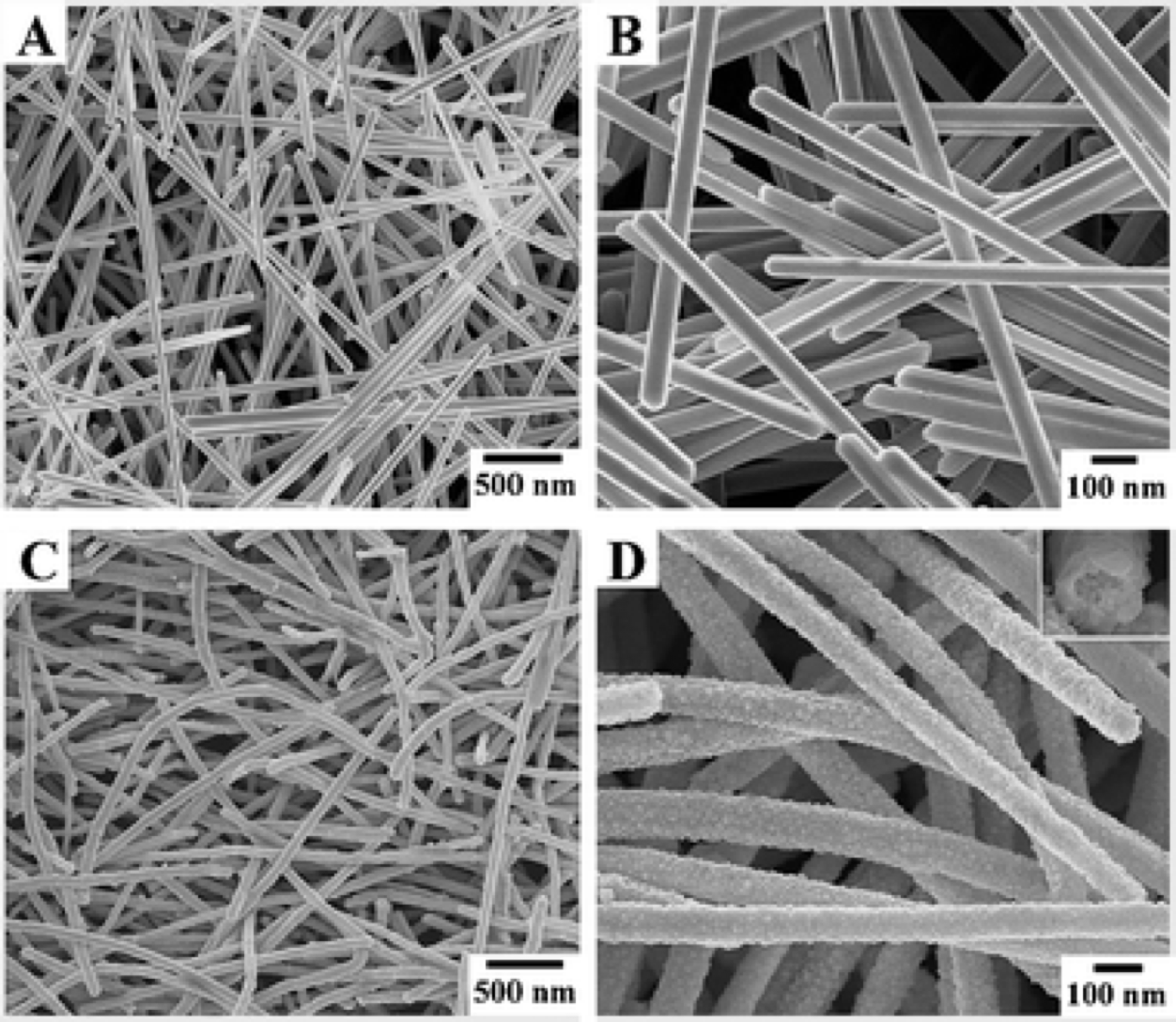
The Real World#
Photocatalyst |
Catalytic nanoparticles |
 |
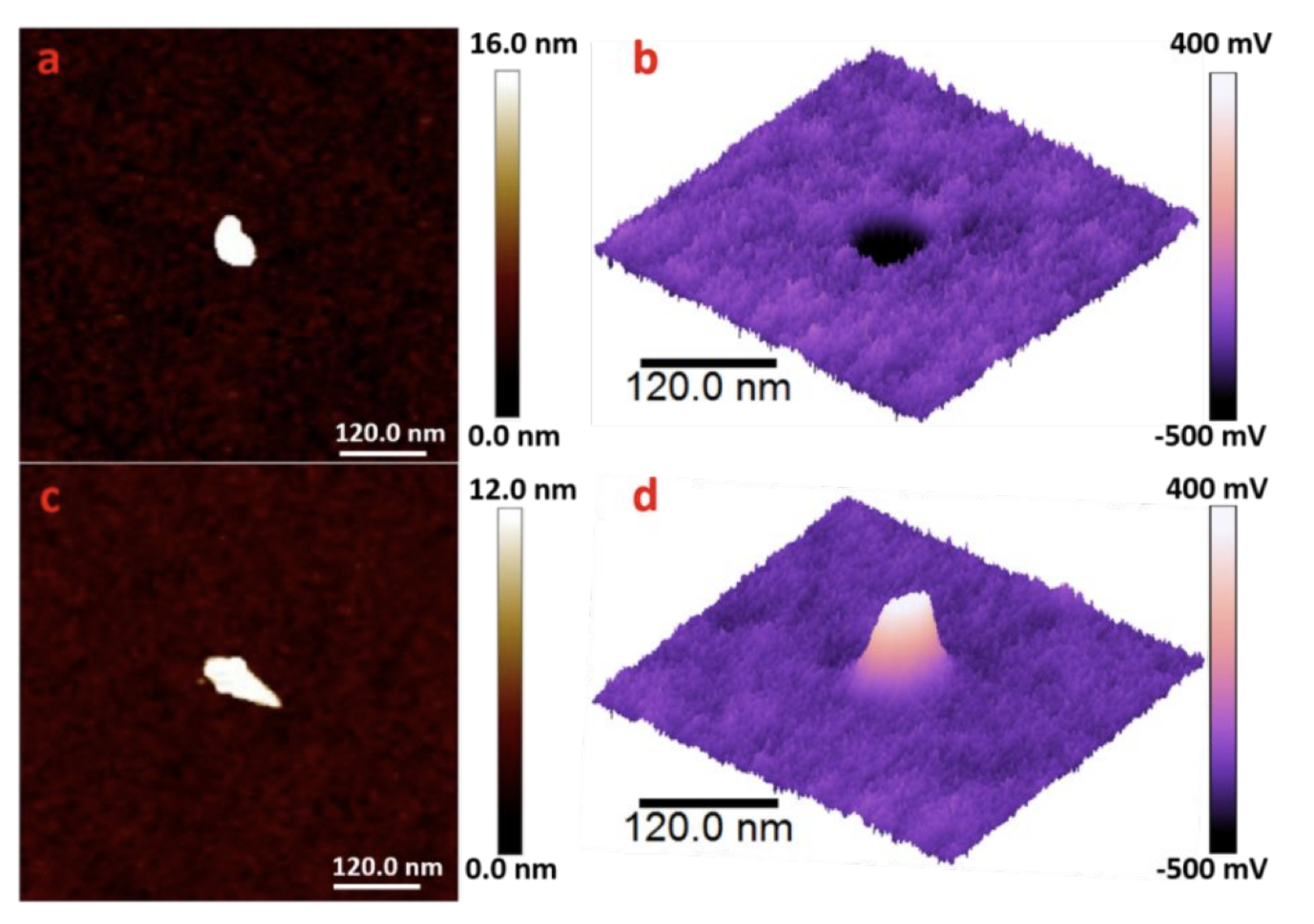 |
| Chem. Comm., 43, 6551 (2009) | PCCP, 21, 15080 (2019) |
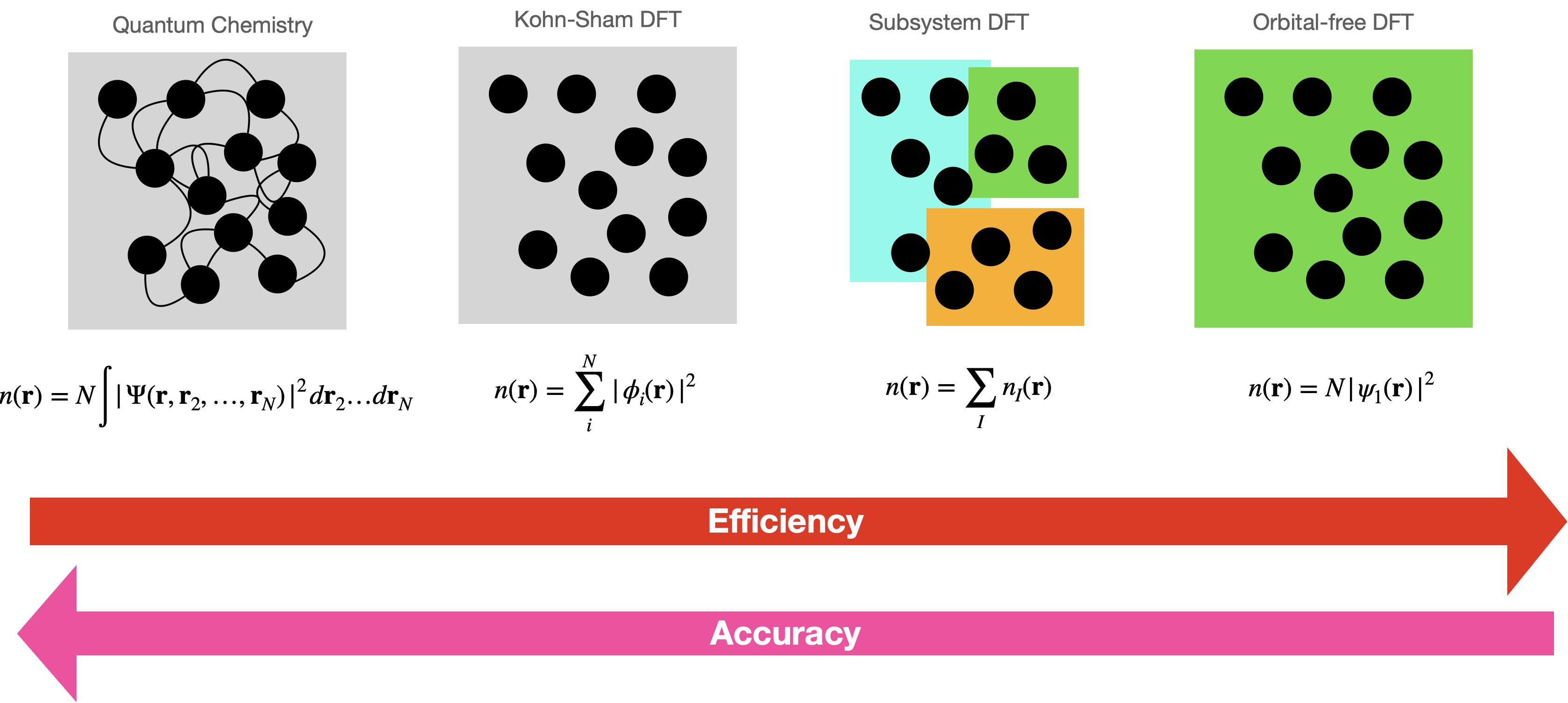
Available electronic structure methods#
Challenge 1#
Let’s check your QM knowledge.
What is the molecular Hamiltonian?

Solution to Challenge #1 and a bit more…#
Molecular Hamiltonian for interacting electrons and nuclei of charge \(Z_\alpha\)
The Schrödinger equation for the ground state of the interacting system
Expectation values of each term of the Hamiltonian
The Hohenberg and Kohn theorems#
Therefore \(n(r)\), \(v_{eN}(r)\) or \(\Psi_0\) hold the same information.
In particular:
DFT exploits the latter as follows:
Challenge 2#
What do the energy functionals mean?
Write an expression for each of the functionals (\(T\), \(E_{ee}\), \(E_{eN}\)) in terms of \(n(r)\) and/or of \(\Psi_0\).

Solution to Challenge #2 and a bit more…#
Recalling:
For the other terms in the Hamiltonian:
$\(
T[\Psi_0] = \langle \Psi_0 | \hat T | \Psi_0 \rangle, ~~ E_{ee}[\Psi_0] = \langle \Psi_0 | \hat V_{ee} | \Psi_0 \rangle
\)$
What can we do with the HK theorems?
Introducing: the Kohn-Sham (KS) system of noninteracting electrons#

Energy functional for the KS system#
where the density $n(r) = \sum_i^N |\phi_i(r)|^2$.
The KS kinetic energy is
Mind: \(T_s \neq T\).
The classical e-e repulsion (Hartree) and e-N attraction:
Challenge 3: What is \(E_{xc}\)?#
Derive an expression for \(E_{xc}\)
Derive an expression for \(E_{xc}\) in terms of \(T\), \(E_{ee}\), \(T_s\) and \(E_H\).

Solution to Challenge #3#
The energy functional, whether KS or interacting, should yield the same energy value, therefore
Can \(E_{xc}[n]\) be approximated?
QEpy uses same structure as QE to specify the
xcfunctional
qe_options = {}
qe_options["&system"] = {}
qe_options["&system"]["input_dft"] = 'LDA'
Typically xc is already specified in the pseudopotential files.
Solving for the electronic structure (find the KS orbitals, \(\{\phi_i\}\))#
To minimize the energy, we define an appropriate Lagrangian:
At the minimum, we impose \(\frac{\delta \mathcal{L}_{KS}[\{\phi_i\}]}{\delta \langle \phi_j|}=0\) or just \(\frac{\delta \mathcal{L}_{KS}[\{\phi_i\}]}{\delta \phi_j^*(r)}=0\), and choose the so-called canonical orbitals (i.e., \(\varepsilon_{ij}=\varepsilon_{i}\delta_{ij}\)).
This yields the Kohn-Sham equations:
where \(v_s(r)\) includes effects of e-N attraction and e-e repulsion. But what is \(v_s(r)\)?
Challenge 4#
Considering the chain rule of functional differentiation (\(\phi^*\) and \(\phi\) are considered independent variables):
Can you derive the KS equations?